October 25, 2013
The Exist Legend
July 26, 2012
Deep Water Lure Color Selection (wonderful color fish can see)
Not all anglers have access to scientist and biologist that they can contact when they have a question concerning the nature and biology of bass. They are at a disadvantage when compared to top anglers when it comes to questions such as, “why are the fish not hitting crankbaits today?” The weekend warrior can’t call up their sponsor and tell them that the shad have a golden glimmer in a certain lake that they are fishing and have a new lure FedEx’d to them over night. Not all of the top anglers have this advantage either, but many professional anglers do have secrets for color choice for crankbaits and other lures that they will keep to their selves. This is a rather long explanation of a theory that is based on science of light and the biology of fish, but it will contain much information as well as some tips for lure color selection. I have heard from several anglers who tell me that they just do not have any luck using crankbaits for largemouth bass, but they see others catching bass on them. The tips in this blog will help you to understand why color is so important as well as help you to catch more bass using crankbaits and other deep running lures as well.
Bass eyes see in water, and our eyes see in the air, but there is an uncanny comparison in how a bass eye sees color and how a human eye sees colors. Cones in our eyes see colors and rods see things in shades of gray. Scientist and biologist have concluded that a bass sees colors much as a human sees colors. This theory is thought to be true for the reason that bass eyes have cones very similar to the cones in human eyes. One difference is the absence of a pupil in the bass eye. This is the part of our eye that dilates or gets bigger when light is dimmed. This would explain why bass are light shy. They are structure orientated for more than reasons than just ambush and shelter, they prefer shade. Bass are most active in low light, morning and evening, but have much better vision in darkness and stained and muddy water than a human would have. A bass eye having no pupil, adjusts to brightness by repositioning the part of the eye called the rods. In bright light the cones are used with a majority of the rods of the bass eye being hidden behind the cones. As light dims more rods are positioned for sight. In dark conditions cones are of less use and the bass sees mostly with rods. To simplify this, cones see colors; rods see shades of gray. In dim light a bass sees in black and white. And a bass's eye has more rods than the human eye and they function better. Thus it sees in dim light much better than a human can. The temperature and density of the water as well as the oxygen of the thermocline will determine the depth the bass will be holding, and this depth will affect the color of a lure such as a crankbait that you will need to fish.
In summer anglers must select a lure that can reach the depth that the bass are holding. Lures such as a crankbait must be selected according to the diving capabilities of the specific lure. The larger the bill or lip on the nose of the lure, the deeper it will dive. Some lures will have the diving depth someplace on the lure and with most crankbaits, the packaging will display the diving depth, one tip is to write this running depth in feet on the lure with a fine point sharpie permanent marker. Also organize your lures by depth then color and label your lure box in the place for each lure with the diving depth. This will help you to quickly decide which lures you will be using, keep in mind that in a tournament time can be money.
Targeting the correct depth is just the beginning, one important consideration also must be made by the angler…What color to use? Deciding by water color and the sky can be a good start, but what about eight to twelve feet deep? Or even for fifteen or eighteen feet deep? If you have you ever noticed the color of a lure seems to change in shallow water and seems to change even more at different times of the day as the sun moves across the sky. This illusion is because of light reacting with water. Anglers need to understand how bass actually see the colors the angler chooses in crankbaits and other lures. Sometimes the color choice is paramount in the success of an angler’s day of fishing. At “different times of day”, or in “different light” and in “different depths” the color a fish sees makes it react.
Studying a simple glass prism will help anglers to see white light change into different colors beginning with the first color red and then moving through the entire color spectrum to the last color of purple. When we see a rainbow in the sky it is the same thing, we see light absorbed and or bent by water. A body of water however has an effect on the light we see as well. The water absorbs light and turns it into heat, or in other words converts light energy into heat energy. In this process some colors are absorbed much more than other colors. When we look at a crankbait in natural sunlight, we see all color waves. This is not possible once the color “wavelengths” enter water. The water actually absorbs the light. Reds are absorbed as heat before other colors while blues and purple are absorbed last.
When we watch programs on WFN with under water footage, the absorption of light is what makes the water appear to be so blue. In water that is pure or perfectly clear, all red colors are absorbed and converted into heat energy before the light reaches 17 feet in depth. After red is absorbed, then all variations or shades of the color orange are then absorbed. Orange slowly fades into a dull yellow as an orange colored lure is fished deep. Shades of yellow are filtered out after orange. And then the shades of green are the next to be absorbed, after this only blue light will remain. Once the blue shades are absorbed, then there is no light. As blue light is absorbed lures appears in various shades of dark blue to indigo, violet and then finally into black. A white lure out of the water still is white in the water, but it gradually reflects light and appears to be green then blue as it goes deeper. A crankbait that may appear bright red on the surface but when cranked into deeper water it gradually changes until finally it is seen as black. This is because the absence of red light in deeper water.
Understanding this theory has apparently helped make KVD and Strike King Millions of dollars as he and the company has become very successful with the multi colored crankbaits in the “sexy shad” color that he has made so famous. For this reason I use crankbaits with an array of colors in both light and dark shades when fishing deep. This provides coverage as sunlight moves as well at different depths. When fishing in 18 feet of water or deeper, I like to start with brightly colored crankbaits. The reason for brightness over just one specific color is that I am looking for a lure that will reflect the least amount of light in the darkness of the deeper water.
When fishing in shallower water the crankbait color choice can be vital, as a bass can see the lure more clearly. “Matching the hatch” with a natural colored crankbait is a good way to choose your lure; however it pays to try a different color if you do not get a bite soon. Many manufacturers do well with natural color patterns on their lures. In shallow water this is very important. When the fish are feeding on shad and there are many of them in a school, many anglers try to choose a lure in a color that stands out amongst the multitude of baitfish and fish the lure below the school. Citrus Shad, Bluegill, and other bright colors, seem to make the lure stand out in a crowd so to speak. Knowing the bass feed on the stray shad that leave the school due to injury or weakness. This natural selection is helped by a color that makes a target stand out a little more than the rest.
As with any crankbait or other summer lure presentation, always start moving the lure fast. If you are not soon rippin’ some lips, change your retrieve to a stop and go or slow it down to a crawl. As Bill Dance has often said, “let the fish to tell you what they want”. I hope this information and tips for color selection help you to more effectively take advantage of many colors that crankbaits and other lures are available in, while fishing deep structure as well as shallow water this summer.
April 16, 2012
Clearly Russian Actor
some of the pictures of Germans shown as totally inhuman and as monsters were fakes manufactured by the Soviet propaganda machine

August 03, 2010
Catching Big Trout on Ultralight Tackle
Late-Summer Bass Fishing Tips: Where and How to Catch Largemouths
By late summer, bass fishing is not for the faint of heart. Largemouths are often deep and lethargic, and they’re also frequently starting to relocate and suspend at middepth ranges as forage begins to move. This is when professional anglers start following the ABCs of summer fishing. • “The ABCs stand for aquatic vegetation, bridges, and current, three shortcuts to finding fish,” says veteran tournament pro and Lake Fork guide James Niggemeyer. “In summer, bass need shade, cover, oxygen, and food, and the ABCs always provide that. In addition, aquatic vegetation and bridges have depth changes close to cover, and current in the back of a creek attracts bass from other areas.”
for strength and low visibility.
April 21, 2010
Google discloses censorship demands to users
March 05, 2010
March 01, 2010
RB26DETT

- Nissan Skyline GT-R R32
- Nissan Skyline GT-R R33
- Nissan Skyline GT-R R34
- Nissan Stagea 260RS
- Tommy Kaira ZZ II
RB26DETT Z2
January 18, 2010
December 25, 2009
The fuel that can change the history of humanity
ELIMINATING GASOLINE AND DIESEL FROM THE VEHICLES
It is not the first time that the engineer Antonia Ibañez de Alba rings the bell. He has to his credit a range of patents with diverse applications.
16th June 2008. The engineer Antonio Ibáñez de Alba, s director general of laboratories Alba Montecristo de Ciudad Real, has developed an explosion kit, which can attached to any vehicle like motorcycles, cars, trucks etc that work on petroleum fuel, without making any modifications to the engine.
According to the study, existing engines develop the movement through the explosion of gasoline or diesel fuel, which is produced inside the cylinders, whereas with this "micro-explosion" it will generate a pressure that moves the pistons, causing the movement.
The engineer while making his presentation commented that the installation of the kit in any kind of vehicle will be “fast and easy”, without any kind of modification to the structure of the engine.
Although Ibáñez did not specify the nature of solid-liquid combustible, he assured that the price of the fuel will be about 40% of the current price of a barrel of petrol, based on the price of the raw materials needed to make this solid-liquid combustible.
In fact, in comparison with one litre of petrol, the price of the new combustible will be between 0,48€ and 0,52€ depending on the quality of the components.
And as for the gases emitted, in the proposal they specified a filter with specific chemical substances, because of which the new fuel would produce only 10% of the pollutant gases emitted by cars now.
The user of the car will be able to choose the kind of fuel he wants to use, because the installation of the kit will not eliminate the use of the original fuel of the engine. This means that the engine will be a type of “Hybrid”, being able to choose the type of fuel or using the one more easily available.
In fact, the engineer explained that the sale price to the public could not be assessed, but that the price of the materials used in its construction makes it very affordable and moreover, with mass production will drastically reduce its costs.
Saving 50% For example, a diesel vehicle of 100 CV that consumes 5.2 litres for 100 kilometres , at current price of 1.32€, would cost 6.86€ to cover a distance of 100 kilometres, meanwhile with the kit installed and using solid-liquid combustible, the same distance would be covered for a cost of 2.5€ or 2.7€
Likewise, he thinks that by installing and using his kit of solid-liquid combustible in all kinds of vehicles, will lead to saving almost 50% of petrol used in the automobiles in the next three years, and its complete suppression in the next 10 years.
The research and development of the prototype has been on since 2004 in the laboratories of the Alba Montecristo group in Daimiel (Ciudad Real), under the guidance of Antonio Ibáñez de Alba and his team of engineers consisting of Ino Feijoo, Francisco Javier Avileo and Oscar Campos, in collaboration with the industrial designing company Nova Diseño, of Ciudad Real.
Air Car Engine
- 1.Actual efficiency of the engine 80%
- 2.Engine works in cold conditions, temperature reached is 45-50%
- 3.The engine life is four times more than that of internal combustion engine, thanks to the low working temperature.
- 4.The working life of an engine reaches 3.600.000 km
- 5.The blasting chamber is separated from the engine set, in this way it transmits minimum heat.
- 6.A kit can be installed in the internal combustion engine to use new combustibles, not needing any major modification 7.but the kit costs between 1.500€ and 2.000€
- 8.The kit can be installed to any kind of explosion engine (motorcycles, cars, trucks, agricultural vehicles) without 9.annulling its use of original combustible. This means that it could choose the kind of fuel to be used. These are called 10.HYBRID ENGINES. The approximate cost of this kit will be between 1.100€ and 2.000€, installation included.
- 11.The gases emitted by the exhaust pipe are reduced by 90%, making it ECO-FRIENDLY ENGINE
- 12.Fuel prices are between 0.08€ and 0.10€, depending on the quality of the components.
- 13.Care and maintenance for a cold external engine are minimum compared to a traditional engine.
- 14.The raw material reserves of the world ate 20 times more abundant than that of petroleum. In Spain grand 15.reserves of different kinds are found.
Recording precious moments on video has become a lifestyle for many people, but carrying a bulky camcorder can be a hassle. iRes Technology introduces a camcorder that may well become the standard for convenience. The uCorder IRDC250 Camcorder-Webcam combo is a step higher from its IRDC150 predecessor as it not only allows you to record videos while simply clipping the mini-camcorder in your shirt pocket or wearing it with a lanyard, but also works as a webcam when plugged to a PC or Mac.
This wearable video camera recorder only measures 3.5 inches in length and can record VGA-quality video files with audio in AVI format at 640 x 480 resolution (pretty much the size of a YouTube player). It has an internal memory of up to 2GB, which is expandable up to 8GB with an optional microSD card. The uCorder IRDC250 can record up to 7 hours of video on expanded memory and has a USB plug for easy file transfers to any computer, without the need for added software. The USB connector also serves as its power charger.
Other features include a LED flashlight, neck strap, clothing clip, USB cable, and clip-on bracket. Because of its size, you have to take note that this mini-camcorder does not have a viewfinder.
The uCorder IRDC250 Camcorder-Webcam Combo is available on iRes official website for only US$99.99, plus shipping and handling.
$75 Tablet Concept
Despite the criticisms of being quixotic about its plans, the One Laptop Per Child project (the group behind the XO, also known as "the hundred-dollar laptop" before being priced at US$172 upon release) is gunning for something big in 2012 with its XO-3 tablet. Geared for children in developing countries, this 8.5-by-11-inch tablet computer is said to be priced at only $75.
The XO-3, which is half the thickness of an iPhone, will feature a touchscreen display with a folding ring on one corner for easier handling and a camera at the back. It will also have no physical keyboard or buttons. To keep the price at a down-low, this tablet will feature induction charging, pretty much like how Palm Pre is charged by placing it on the Touchstone, and will use an 8GHz processor and Pixel Qi display. The OLPC also aims the XO-3 to be highly durable, all-plastic, and waterproof.
How would these technologies become accessible before the Earth tilts by its side? The OLPC simply allows any other PC maker to take over the project, their way of pressuring the industry to provide cheaper and more education-focused PCs.
And while we wait for the XO-3 to become a reality, OLPC is set to release newer models beginning January 2010, starting with the $200 XO-1.5 that uses a VIA CPU instead of the AMD version in the pioneer model, which would double the speed, as well as provide four times the DRAM and Flash memory. The group will also release the XO-1.75, which will feature rubber bumpers on its casing and an 8.9-inch touchscreen display. The XO-1.75 will have a Marvell ARM processor that enables twice the speed at a quarter of power usage. Sorry, though, no XO-2.0.
September 03, 2009
Nike One
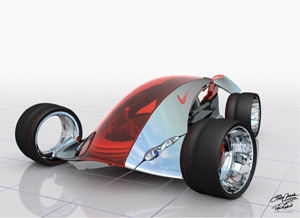
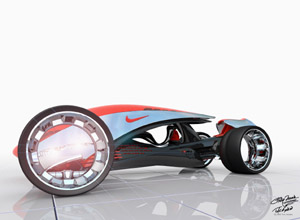
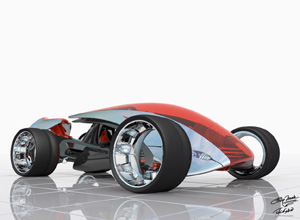
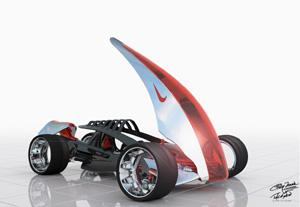
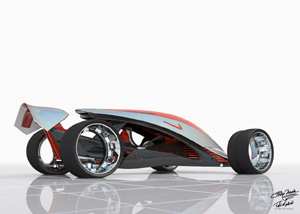
The Nike ONE was designed by Phil Frank and Takuya Asano. Phil Frank, also responsible for the design of the Saleen S7, led the small design team, and kept the concept true to Nike's sporting pedigree. While the shape of Nike One is taught and dynamic, the real genius lies beneath the skin.
The designers wanted to make the car an extension of the future athlete, and as such, control inputs are made through the main muscles of the legs and arms, the Nike ONE requires peak physical perfection for maximum performance. The drivers sits in a laid-out-motorcycle rider position, their feet harnessed into pedal bike like clip-on foot pegs, and their hands are connected to the vehicles CPU via non-invasive bio-ports which allow for a direct man and machine neural interface. This enables the driver to fine tune the control inputs by the power of thought. This is a concept remember.
The fictional 'history' of the Nike ONE's development is a well thought out and thoroughly entertaining story. It begins in 2012 with Nike inventing a 'Spark Suit'.
The Spark Suit was originally designed to provide resistance training to athletes by hindering movement and therefore building muscle and improve coordination. The suit used the wearers energy to provide electrical energy, energy which was initially dissipated in the form of light. Nike engineers soon realised however that this energy could be stored and used later to power electrical systems.
In a slightly implausible, but still clever future vision, the worlds population began to make all their electrical power simply by living more active lives. Obesity and ill health are all but eradicated. In this super-fit future world the Nike ONE steps in as a racing vehicle. Powered by the energy stored from the drivers activity, the Nike ONE is capable of 230 mph. Top drivers of the Nike ONE become revered and famous athletes. To compete at a high level the drivers must train vigorously to power the cars batteries and attain the stamina required to drive this 230 mph gym.
The Nike ONE driver, seated on a Nike SHOX suspension seat, is assisted with a heads-up display showing race line tracking, energy reserves, and vital information. The teardrop-like glass is NikeMax Optics Smart Glass with the ability to change color for optimal contrast and clarity. The hub-less wheels with in-wheel motors and variable profile tires are attached to carbon fibre and titanium weave suspension and frame components.
“You don’t just drive this vehicle, you are a part of it,” explains Phil Frank. This is what a concept car should be.
April 27, 2009
TOYOTA WINS FIRST HYBRID

Toyota's Tokashi 24-Hour motor race win marks the first time that a Hybrid race car has ever won a competition. In 2006 Toyota was the first manufacturer to enter a hybrid vehicle, a Lexus GS450h, into the Tokashi race, hoping to discover how to make hybrid systems both more efficient and lighter. Utilizing data from last year's race, where the Lexus GS450h finished 17th, Toyota has now been able to develop a special racing unit "to test the limits of hybrid performance." The advanced hybrid technology can be used in future hybrid production cars. The Denso Toyota Supra HV-R weighs 1,080 kg (2376 lbs) and produces a maximum output of 480 hp at 6,800 rpm. For more specifications, see press release. Press release, car specifications and pictures after the jump.